The switch 2 is all the rage now. But how about modchipping the OG
switch ? You'll get proper full access to your console, including running
Linux or Android,
using
non-switch controllers, retroarch and lots of other homebrew goodies.
How to do it
There is a very well-written guide that takes you through the entire
process. If you have one of the early switches, you don't actually need to
modchip the switch.
Based on the guide it seems pretty important to disable "Automatic Save
Data Cloud" before starting. I think this is a paid Nintendo service, but it
didn't concern me. You can read up on the different kinds of custom firmware
(CFW), but it basically seems like emuMMC is what most people will want, as
it's completely separated from the stock firmware. Again, the guide has a much
better explanation of the pros and cons.
The entire process does take some time. Maybe set aside one or two days if
also installing the modchip, this way you'll have plenty of time to understand
what's going on in each step.
Removing the IHS
I stumbled at step 4 of the modchip installation
guide: removing the internal heat spreader (IHS). It's not obvious that
the little metal shield hooks over little L-shaped hooks that are on the
motherboard.
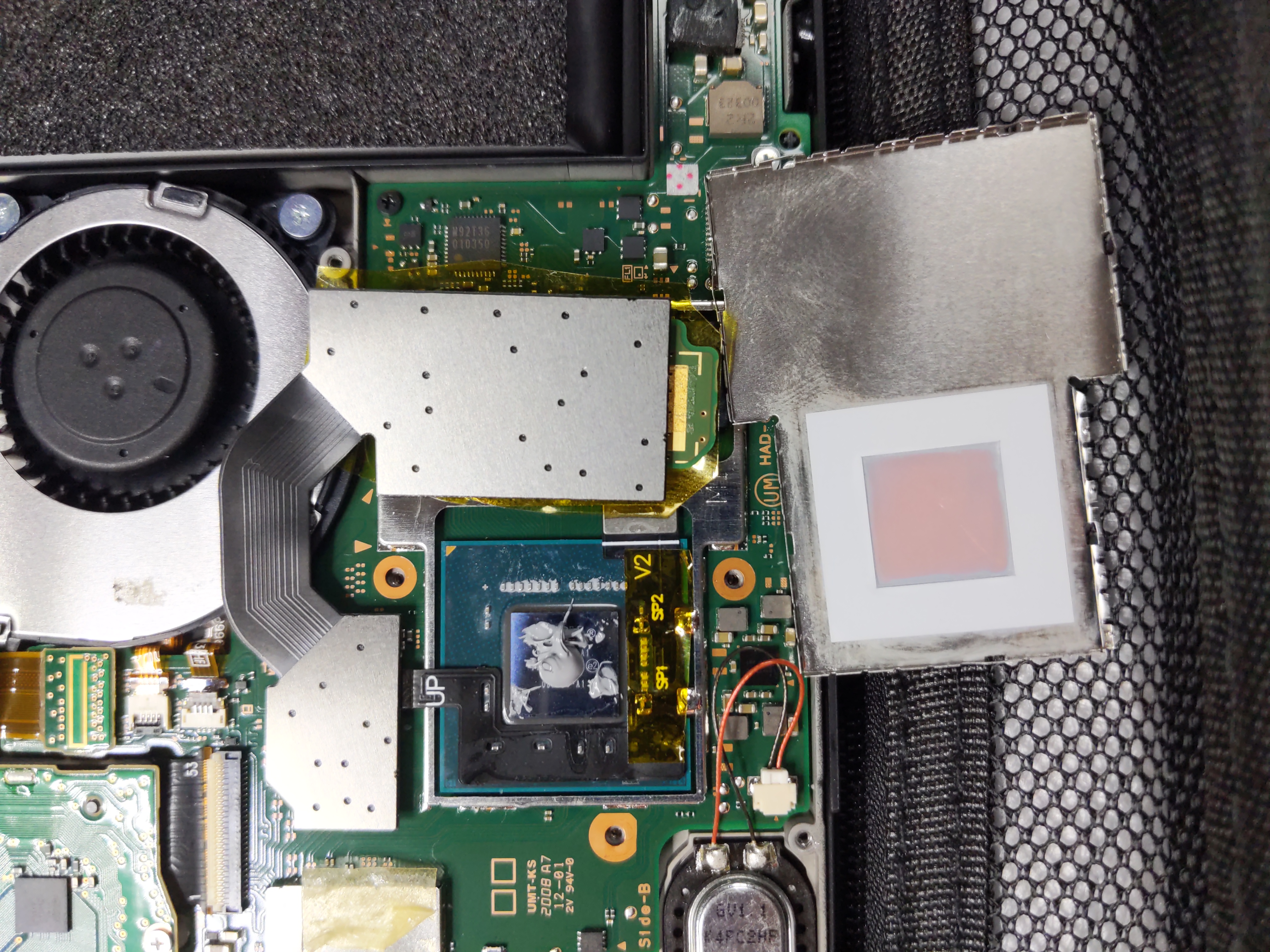
Here the IHS is removed and flipped over on the right. The copper-colored
patch on the IHS is what makes contact with the SOC. Some thermal paste (grey
goop) is already on the SOC for reassembly. Along the edge of the IHS are the
holes which clip it onto the metal frame on the motherboard. The bottom right
edge of the IHS is bent flat so that the ribbon cable can pass out from under
the IHS (the black cable marked "UP").
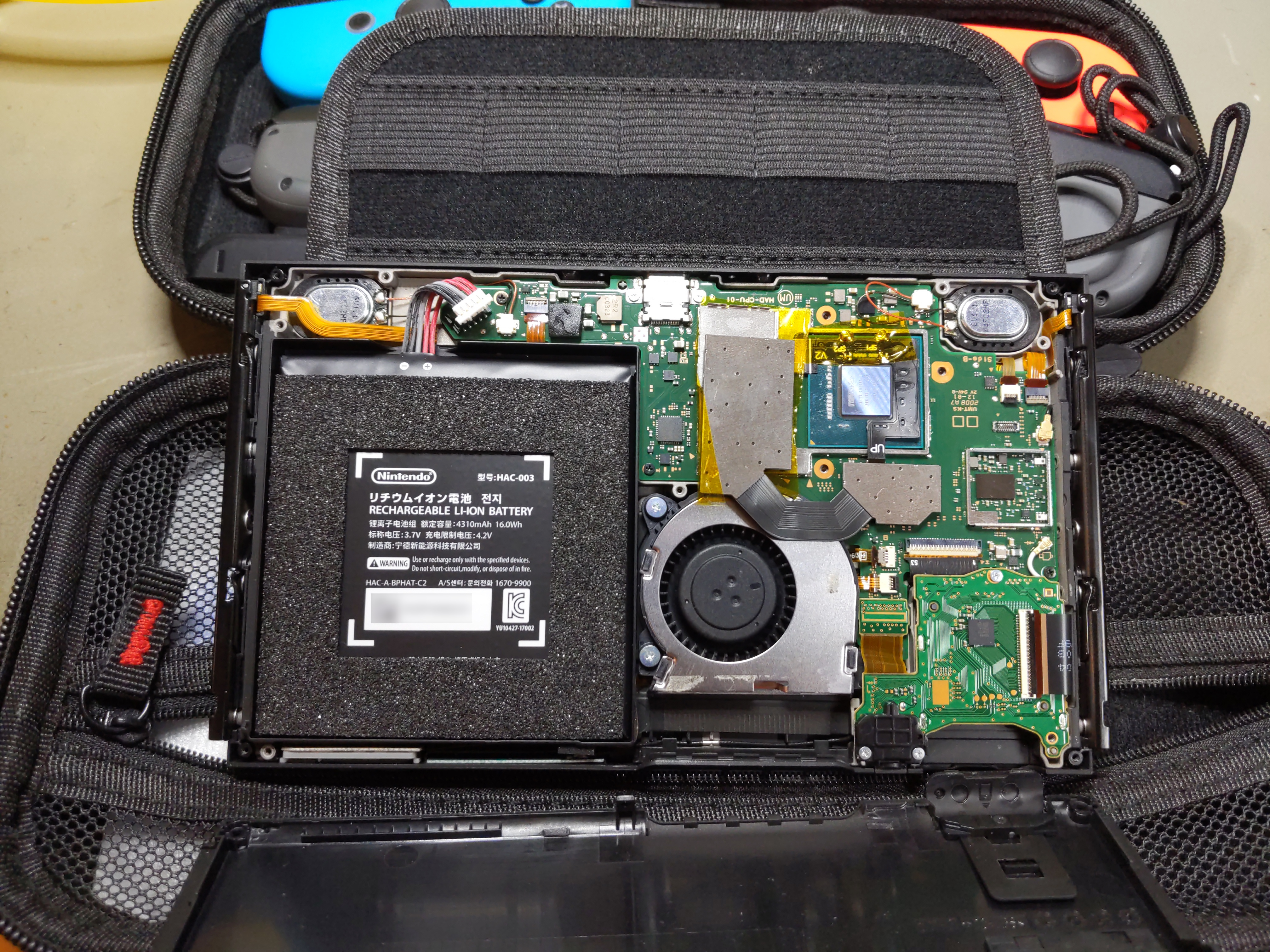
Disassembled switch with installed modchip. At this stage you can boot the
switch to the stock firmware to ensure the modchip installation worked.
Another thing which caused me a little undue worrying were the diode
readings that are specified in the guide. As the guide says, they're really
rough indications. My readings were about 10-fold off and the switch still
booted correctly with the modchip.
The guides are fantastically written and easy to follow. The modchip
installation does need some precision soldering. I have done just a bit of
surface-mount soldering and everything went fine as I really took my time to
do a good job. If you've never done any soldering before this is probably too
big of a first soldering project.
Mainline linux, if only
This is a pretty unique computing device if you think about it. It's
convergent in the sense that it can work both docked and undocked. The
main input methods are a touchscreen and joycons/gamepad. So kind of a new
format between a smartphone and portable console. The form factor could
be really interesting for travelling, the screen size is something in
between a phone and laptop. Like a tablet, except you can also dock it so
it becomes more like full-blown desktop.
As could be expected for a proprietary device, the linux kernel that
nvidia provides is non mainline and stuck at some old version. That hasn't
stopped the devs of switchroot to get linux and android working, including
essentially all the peripherals. This means it can really function as a
full desktop computer with HDMI out, USB, bluetooth, wifi and all the rest.
Someone has even started a postmarketOS
device port for the switch, although it doesn't boot yet. However this is
based on a mainline linux port for the switch, potentially being more viable
in the long-term. To follow-up on in the future.
This circles back to thoughts on DRM and lack of innovation. The form
factor here is novel, especially in the landscape of glass-slab phones and
laptops which are so conservative and unchanging. But to actually break the
switch out of random limitations decided by the manufacturer someone has had
to reverse engineer the low-level cryptography of the SOC and we've had to
solder on a chip to the resistors directly on the SOC. Quite a lot of work to
use a device that you're the owner of. There's so much more possible with the
hardware we already have, we're just being kept back by greed and profit.